


Revision (secondary) rhinoplasty
in Moscow
Secondary rhinoplasty is a repeat operation after a previous nose correction. It is also called revision rhinoplasty. Reasons for an examination may be dissatisfaction with the shape of the nose or difficulty breathing after the first procedure. The decision on a repeat correction is made after assessing the tissues, the stage of recovery and possible limitations.
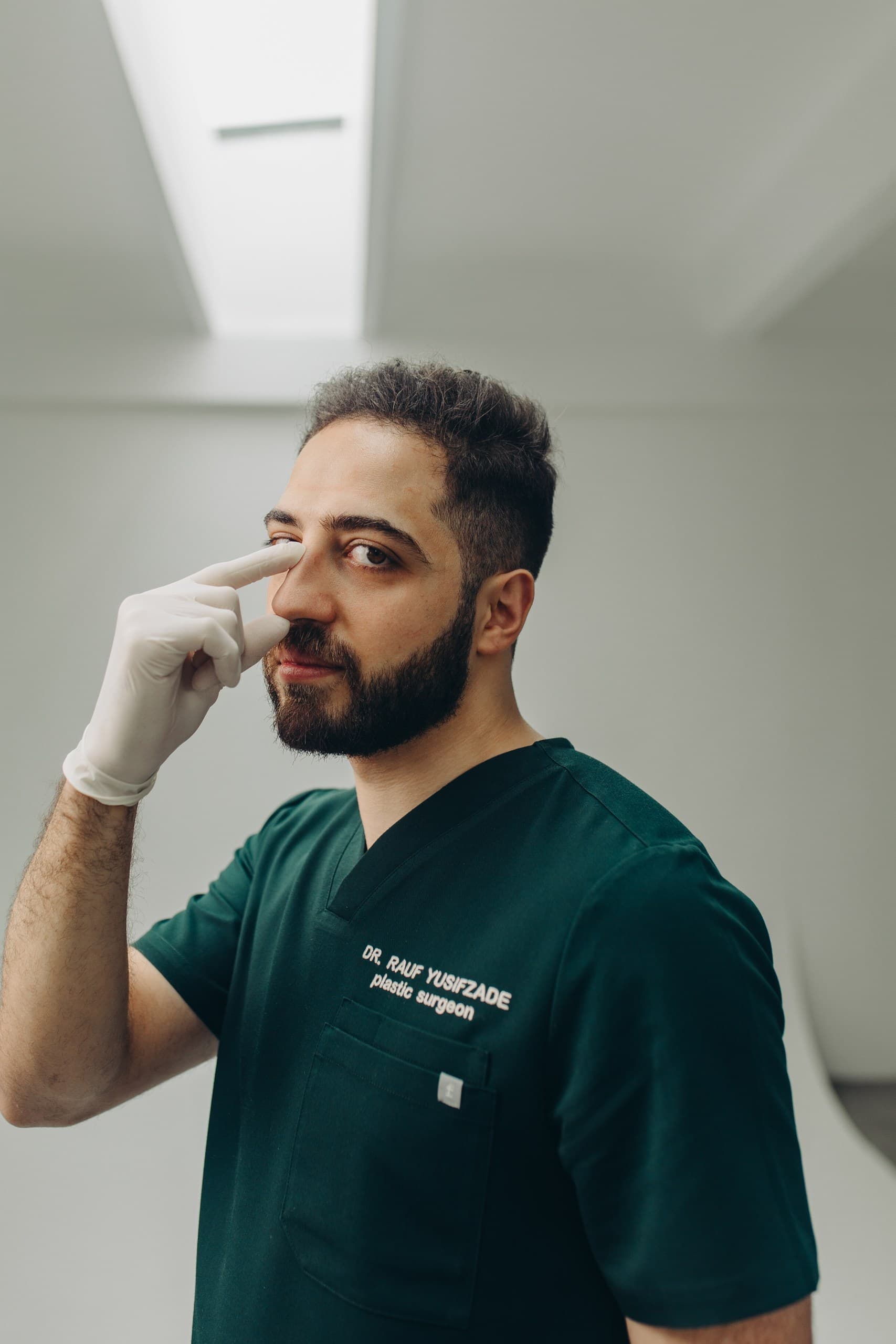
Plastic surgeon Rauf Yusifzade specializes in complex reconstructive procedures in Moscow, precisely correcting the effects of unsuccessful rhinoplasty and giving patients back their self-confidence.
What is secondary rhinoplasty and why is it harder than primary surgery?
Correcting someone else's mistakes is always harder than operating on untouched tissue. With a repeat case, an experienced surgeon faces altered anatomy: the doctor cannot know for sure how aggressive the first procedure was.
The main challenges of a repeat operation:
Tissue deficit
There is often a shortage of the patient's own cartilage, so to reconstruct the bridge or tip of the nose the surgeon has to use autografts (rib or ear cartilage).
Scarring
Internal scars distort the shape of the nose and make it harder to separate the tissues.
Functional problems
Besides aesthetics, the doctor needs to restore breathing if the nose stopped working properly after surgery.
That is why such a procedure should only be entrusted to a highly qualified plastic surgeon with microsurgical precision.
Indications for a repeat operation:
when does a nose need to be redone?
The decision on repeat surgery is made if the patient has objective complaints about aesthetics or health. The main indications include the following. If your operation was recent, read what to do when your nose looks crooked after rhinoplasty.
- Asymmetry and a crooked bridge
- A deformed tip (too narrow, drooping or asymmetrical)
- A bony callus (a new hump)
- Difficult nasal breathing (when the patient complains that the nose does not breathe)
- Excessive tissue removal during the first operation (a "pinched" effect or saddle deformity)
- Rough internal or external scars
Preparing
for surgery
The success of the correction largely depends on careful planning. At the initial consultation Dr. Yusifzade studies your medical history in detail, assesses the current aesthetic parameters and carries out 3D computer modeling of the future nose shape.
A computed tomography (CT) scan is ordered for an objective assessment of the internal structures and condition of the nose.
Before the surgery you also need a standard set of tests:
- Complete blood count and blood chemistry
- Coagulation panel (clotting assessment)
- ECG and chest X-ray
- Tests for infections
Proper preparation minimizes all risks during the surgery and the subsequent recovery.
How the surgery is performed:
methods and stages
The technique of reconstructive surgery is chosen individually. The procedure is performed only under general anesthesia to ensure the patient's complete comfort and safety.
In most cases the doctor uses the open approach. A neat incision is made across the columella (the strip between the nostrils). This gives the surgeon full visual control over the surgical field, which is critical when working with damaged cartilage and scars.
The main stages:
Separation of the soft tissues and removal of scars from the previous operation
Restoration of the framework with the patient's own cartilage (if needed)
Shaping the correct projection of the bridge and tip of the nose
Restoring breathing function (septum correction, work on the turbinates)
Cosmetic stitches, silicone splints (instead of outdated gauze packs) and a fixing dressing
Rehabilitation time
and recovery after revision rhinoplasty
Tissue healing after repeat surgery is always slower and requires more patience. Rehabilitation can take 6 to 12 months, because the surgeon works with structures already altered by scarring and with impaired blood flow in the correction area.
Swelling and bruising are naturally present in the first days. However, thanks to Dr. Yusifzade's modern gentle techniques (including a piezo device when work on the bone is needed), early recovery after revision rhinoplasty is as comfortable as possible. The silicone splints are removed on day 2-3, and the thermoplastic fixing dressing comes off after 10-14 days.
For successful healing it is important to strictly follow the doctor's recommendations:
- Sleep only on your back
- Avoid physical exertion and sports
- Avoid any heat treatments (baths, saunas, tanning beds)
- Do not wear glasses for 3 months, so as not to deform the still fragile bridge of the nose
Before and after photos
of correcting failed rhinoplasty
No promises are as convincing as a real portfolio. Our gallery shows before and after photos of secondary rhinoplasty, where you can see the doctor's outstanding skill for yourself.
Rauf Yusifzade is rightly among the specialists recommended as the best rhinoplasty surgeons for the most complex reconstructive cases. The photos clearly show successful correction of the nose after surgery (correcting failed rhinoplasty), removal of asymmetry, recreation of a natural tip and the return of harmonious facial proportions.
 Before / After
 Before / After
 Before / After
Patient reviews
For many patients Dr. Yusifzade becomes the specialist who not only corrects other people's mistakes but also gives them back the joy of life. Reading reviews of revision rhinoplasty after surgery, you will often find sincere words of gratitude: patients write that their nose finally breathes, they are completely happy with the result, and they call the doctor a true professional and a born surgeon.
People highlight not only the flawless aesthetic result but also the attentive care at every stage of treatment. You can read detailed reviews of recovery after rhinoplasty to learn more about our patients' personal experience and their rehabilitation period.
Operated: October 2025
I came to Rauf Vugar oglu with a big problem - my nose had been badly damaged by two rhinoplasties! The crooked nose needed to be straightened and my breathing restored. At the appointment the doctor listened very carefully to my wishes, explained all the details and made it clear that the problem c...
Translated from the original Russian
More reviews on

Operated: May 2025
Good afternoon. I had revision rhinoplasty on 29.05.25 with Dr. Rauf Vugarovich Yusifzade. I am very happy - the doctor gave me a perfect nose. He restored my breathing, because after the first surgery my nose did not breathe. I also want to mention the doctor's assistant, Marina Timurovna, who kept...
Translated from the original Russian
More reviews on
Operated: March 2025
I came to Rauf Vugarovich for a consultation about secondary rhinoseptoplasty after an unsuccessful first surgery by another surgeon. At the consultation the doctor spoke politely, put me at ease and answered all my questions. I chose this surgeon and have never once regretted it. In March I had the...
Translated from the original Russian
More reviews on
Revision rhinoplasty prices
cost of the surgery
The complexity and extent of reconstructive surgery are always individual: whether rib cartilage needs to be harvested to rebuild the framework, and how much scarring and deformity there is. All of this directly affects the cost. If you need secondary rhinoplasty in Moscow, an exact estimate can only be made after an in-person consultation and examination.
The price list below shows approximate prices. The final price of secondary rhinoplasty is calculated transparently. At Dr. Yusifzade's clinic it usually includes the surgeon's work, high-quality anesthesia, all necessary consumables and a comfortable hospital stay.
Revision rhinoplasty (after a previous septoplasty)
$8,260
Revision rhinoplasty (secondary rhinoplasty)
$9,800
Septoplasty
$2,800